


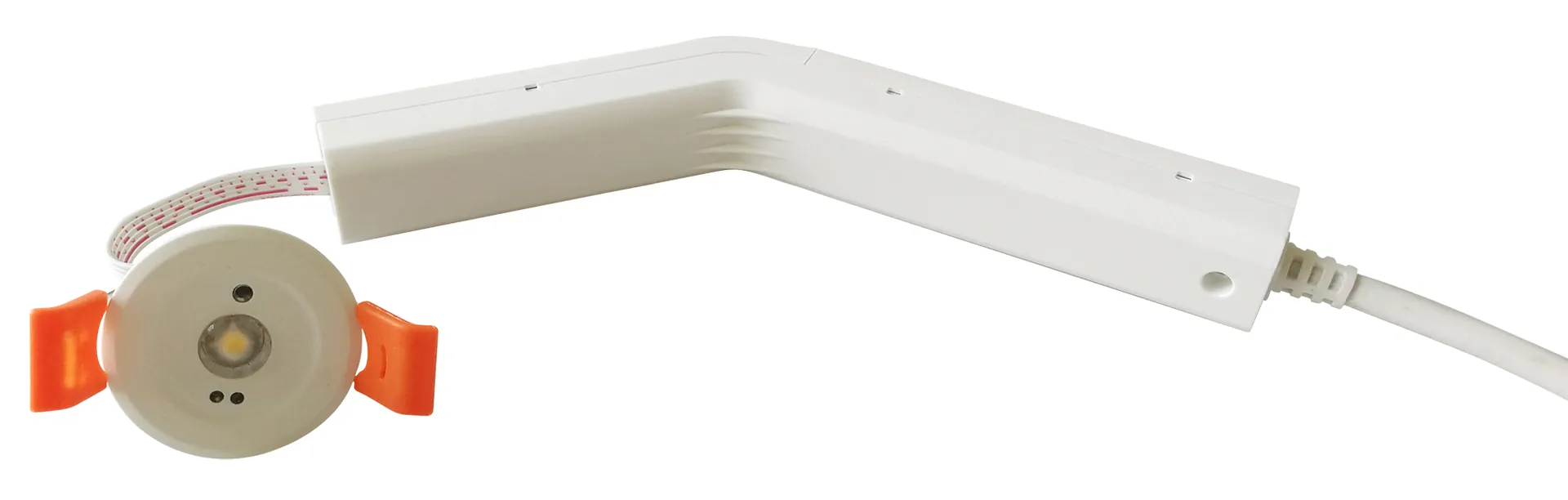
Our fully compliant Mini Max range includes non-maintained open area and corridor downlights, these offer a staggering 180 lumens for the 1.5W version, all thanks to the design and technology that drives all our products.
Questions
Where would I use Mini MAX downlights?
Where space is tight: their reduced size makes them ideal for shallow ceiling voids and small spaces. With open area and corridor lenses they suit corridors, rooms, paths and open spaces.
How much light do Mini MAX downlights give?
At 1.5W, 190 lumens with the open area lens (125°, DLC1.5-OA2-AST) and 180 lumens with the corridor lens (DLC1.5-C-AST).
How long do Mini MAX downlights last in a power cut?
3 hours. Mini MAX downlights give constant emergency light for the full 3-hour duration, and the battery recharges in 8 hours (the first charge takes up to 16).
Are Mini MAX downlights maintained?
No, they are non-maintained: they light only when the mains fails.
Can Mini MAX be used in wet areas?
No. They are IP20, designed for indoor use, and fully compliant with BS EN 60598-2-22 to support emergency lighting designs to BS 5266.
How are Mini MAX downlights tested?
By hand (Manual Test) or with Advanced Self-Test (AST). Self-test is switched off when they leave us: switch it on with the ARC remote control. There is no Eyeris version of Mini MAX; MAX and VISUAL have them.
Do Mini MAX downlights come in black?
Yes, both: DLC1.5-OA2-AST-BLK (open area) and DLC1.5-C-AST-BLK (corridor), alongside the white ones. Choose Black under the photo to see it.
What battery do Mini MAX downlights use?
An environmentally friendly lithium-ion battery, with a standby power of just 0.5W.
What warranty do Mini MAX downlights have?
Up to 5 years on the luminaire and battery. Every product has 1 year as standard, and 5 years from the date of invoice once you register it within 6 months of purchase (a new product, bought from Z10 or an authorised reseller).
Where is the Mini MAX datasheet?
On the Specifications & downloads tab, beside each model: its datasheet, and the IES and LDT photometric files and spacing tables where it has them. For help with a layout, ask for our free lighting design advice.